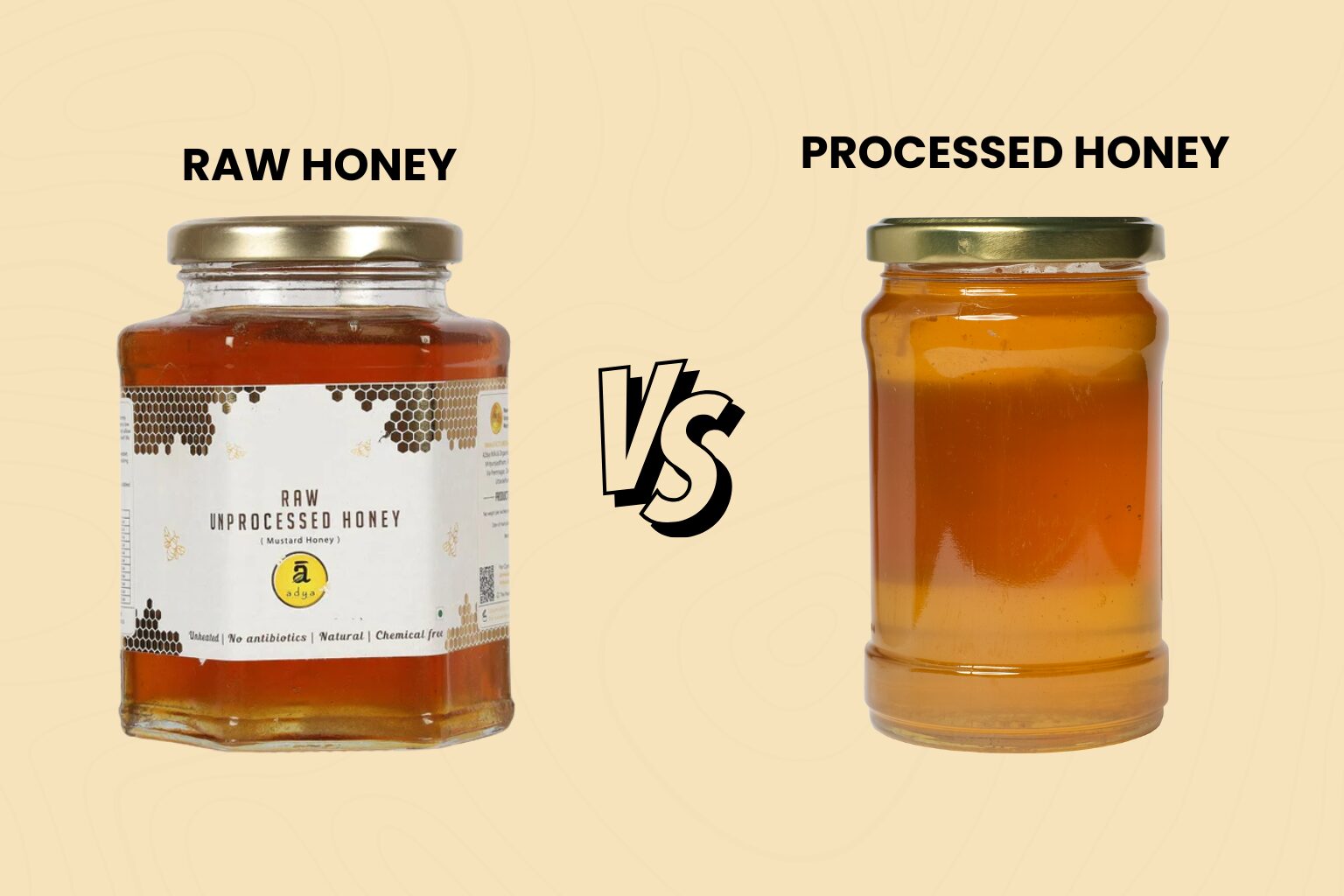
Honey jars might look the same on the shelf. But not every jar or brand is similar. When you look closely, you will notice that there is raw and processed honey. This difference will have an impact on aspects like:
- Nutrients
- Taste
- Texture
- Uses in the kitchen.
If you use honey on a regular basis, it is good to know how these two forms differ. This will help you choose the most appropriate one to use.

Summary
show
Raw vs. processed
Raw honey has been taken out of the hive directly. It has been slightly strained to catch the large debris, such as wax or bee parts. It is not heated to high temperatures. Also, it does not undergo too much filtering. As a result, this type preserves more of its naturally occurring components.
Processed honey, on the contrary, is usually heated and filtered. Heating facilitates the bottling process. This also prevents crystallization. Filtration eliminates pollen and minute particles. This results in a clear and consistent product.
Neither kind is inherently bad. But they serve different purposes. We will look at more differences below.
Nutrient differences
Raw honey is naturally composed of:
- Traces of bee enzymes.
- Small amounts of pollen.
- Antioxidant substances like flavonoids and phenolic acids.
- Minerals, including potassium, calcium, and magnesium in minute amounts.
During the processing of honey, some of the heat-sensitive enzymes and antioxidants may be eliminated or destroyed. This happens when the honey is heated.
Note that pollen adds small amounts of nutrients and flavor to honey. It may also be removed when filtering honey.
That said, Raw Honey is most important when you care about:
- Natural enzymes
- Antioxidants
- Limited processing.
Texture and appearance
One of the simplest methods of differentiating the two forms is their texture.
Raw honey is often:
- Cloudy or opaque
- Thicker or more viscous
- Likely to crystallize over time.
Crystallization is a natural and normal occurrence in raw honey. And that does not mean spoiling. The process gives it a spreadable texture that many people like.
On the other hand, the refined honey is usually:
- Clear and shiny
- Smooth and easy to pour
- Resistant to crystallizing.
Heating removes the natural sugar crystals. This is followed by fine filtration. This removes particles that promote crystallization. The result is honey with a stable and syrupy consistency.
Taste and flavor complexity
This is where raw honey usually excels. It tends to have:
- More complex flavor notes
- Floral, herbal, or earthy taste. This is based on the nectar source.
- A flavor subject to change with every batch.
Raw honey reflects its origin. For instance, a spring wild flower honey will have a different taste than a late summer honey, though they are from the same area.
Processed honey typically has a taste that is:
- Mild and uniform
- Less aromatic
- Sweet. Has no strong secondary flavors.
This consistency may be an advantage if you desire consistent sweetness that does not interfere with other ingredients.
How each type performs in cooking
The purpose is equally important as nutrition or taste.
Raw honey works well when it is:
- Sprinkled on yogurt, toast, or cheese.
- Added to coffee or tea when slightly cooled.
- Applied to salad dressings, marinades, or no-bake dishes.
- Used as a garnish.
Some of the natural compounds found in raw honey may not withstand high heat. Thus, you can use it in recipes that do not need extensive cooking. This will help to maintain its properties.
Processed honey is usually more appropriate for:
- Baking.
- Candy making.
- Large-batch cooking.
- Recipes that involve heating the honey over long periods of time.
The honey has already been heated and stabilized. So, there is not much you are losing by cooking with it. This predictability can also make recipes easier to control.
Shelf life and storage
Raw and processed honey have a long shelf life. But their behavior varies with time.
Raw honey can crystallize or darken with age. When you want it liquid again, place the jar in warm water. However, avoid microwaving.
Refined honey remains in a liquid state over time. This makes it easy to use in your daily routine. It is ideal when you want honey that flows freely throughout the year.
Both kinds do not need refrigeration. You should keep the jar in a tightly sealed container and maintain it at room temperature.
Which one should you choose?
There is no right or wrong choice. It is the use and what you appreciate that matters.
You should use raw honey if you:
- Enjoy nuanced flavors.
- Use it as a garnish.
- Desire minimal processing.
Use processed honey when:
- Frequently cook or bake with honey.
- Prefer mild sugar.
- Desire a predictable ingredient.
The final take
We have learnt how processing influences the nutrients, the texture, and the flavor. You are now in a position to select the type that suits you instead of making labeling selections. The ideal honey is the one that serves your purpose of use.
 I’ve always loved food and I’ve always loved sharing my love of food with the world. This love led me to become a professional foodie, opening my very own restaurant called The Great American Cafe and writing a blog called Foodieso.com, where I’ve been able to share my recipes, ideas and thoughts about food.